

What Is SEO-Friendly Content?
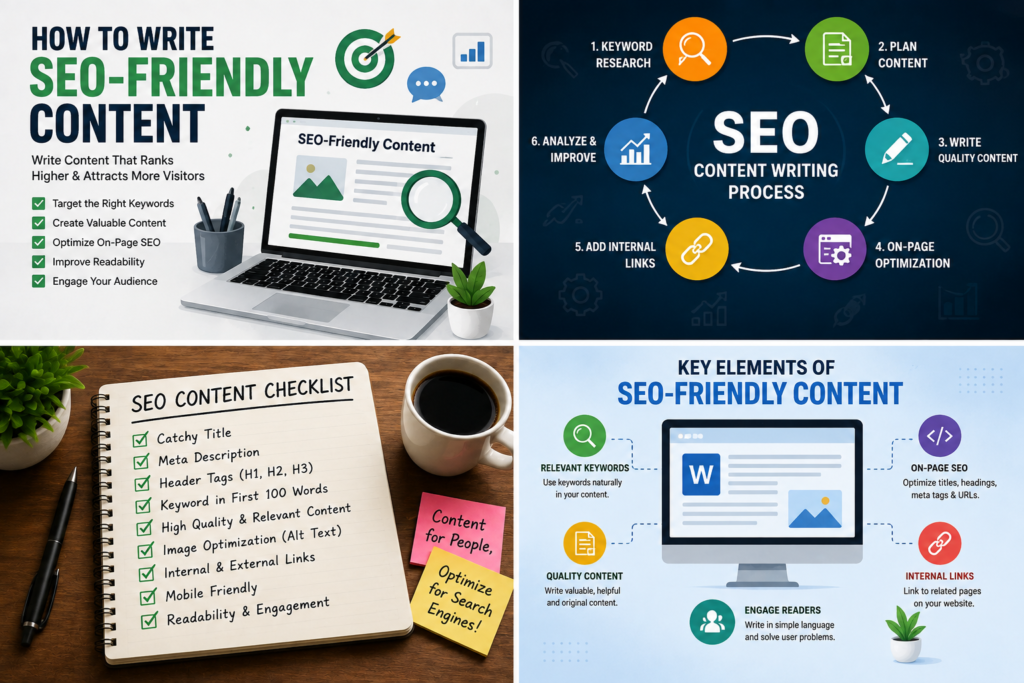
SEO-friendly content is content specifically designed to help search engines understand, index, and rank your pages while simultaneously delivering value to readers. Think of it like building a bridge between what people are searching for and the solutions your content provides. When done correctly, SEO content attracts organic traffic, improves user engagement, SEO-Friendly Content and increases conversions.
The SEO landscape has changed dramatically. Years ago, simply repeating keywords throughout an article was enough to rank. Today, search engines use advanced algorithms and AI systems that understand context, intent, and relationships between topics. Modern SEO content focuses on relevance, expertise, user experience, and semantic optimization rather than keyword stuffing. Search engines now prioritize content that answers questions clearly and demonstrates genuine expertise.
Businesses that invest in SEO-friendly content continue to benefit from sustainable traffic growth. Organic search remains one of the most valuable traffic sources because users actively seek solutions, products, or information. Unlike paid advertising, well-optimized content can generate traffic for months or even years after publication.
Why SEO Content Matters SEO-Friendly Content
SEO content helps websites become visible when potential customers search online. Whether someone wants to learn a skill, compare products, or make a purchase, search engines are often the first stop. If your content isn’t optimized, you’re essentially opening a store in the middle of a desert and expecting customers to find it.
Well-written SEO content improves:
| Benefit | Impact |
|---|---|
| Organic Traffic | More website visitors |
| Brand Authority | Increased trust |
| Lead Generation | Higher conversions |
| User Engagement | Better retention |
| Search Visibility | Higher rankings |
Research and industry studies continue to show that organic search is among the strongest drivers of website traffic and conversions for businesses across industries.
Understanding Search Intent
Before writing a single word, you need to understand why someone is searching. Search intent is the hidden motivation behind every query. SEO-Friendly Content Google rewards pages that match user intent because its goal is to provide the most relevant answers.
Imagine someone searching for “best running shoes.” Are they looking to buy shoes immediately? Are they comparing brands? Or are they simply researching options? Each scenario requires different content.
Informational Intent
Users want knowledge or answers. Searches often include phraseshttps://www.linkedin.com/in/saniya-amreen-67008737a
- How to
- What is
- Why does
- Guide to
For example, “How to write SEO-friendly content” is informational. Readers want education and actionable steps.
Commercial Intent
Commercial searches occur when users compare products or services before making a purchase decision. Examples include:
- Best SEO tools
- Top keyword research software
- Ahrefs vs SEMrush
These searches require detailed comparisons, reviews, and recommendations.
Transactional Intent
Transactional users are ready to take action. Queries include:
- Buy
- Order
- Download
- Sign up
Content targeting transactional intent should focus on benefits, features, trust signals, and clear calls to action.
Matching search intent increases engagement, reduces bounce rates, and improves ranking potential because users find exactly what they’re looking for.
Conducting Effective Keyword Research SEO-Friendly Content
Keyword research remains the foundation of SEO-friendly content. Without keywords, search engines struggle to understand your topic and audience.
The goal isn’t to find the highest-volume keyword. Instead, identify keywords that align with user intent and your expertise. Many successful websites build traffic through long-tail keywords rather than highly competitive phrases.
Finding Primary Keywords
Primary keywords define the central topic of your content. Examples include:
- SEO-friendly content
- Content writing
- SEO copywriting
- Content optimization
Use tools such as:
- Google Keyword Planner
- Ahrefs
- SEMrush
- Ubersuggest
Analyze search volume, keyword difficulty, and relevance before making a final choice.
Using Long-Tail Keywords
Long-tail keywords are more specific search phrases. Examples include:
- How to write SEO-friendly blog posts
- SEO content writing tips for beginners
- Best practices for content optimization
These keywords often have lower competition and higher conversion potential because they target specific user needs. Many SEO professionals report strong success by focusing on long-tail opportunities overlooked by competitors.https://www.linkedin.com/in/saniya-amreen-67008737a
Creating a Winning Content Structure
Structure is like the blueprint of a building. Without it, readers become lost and search engines struggle to understand your content hierarchy.
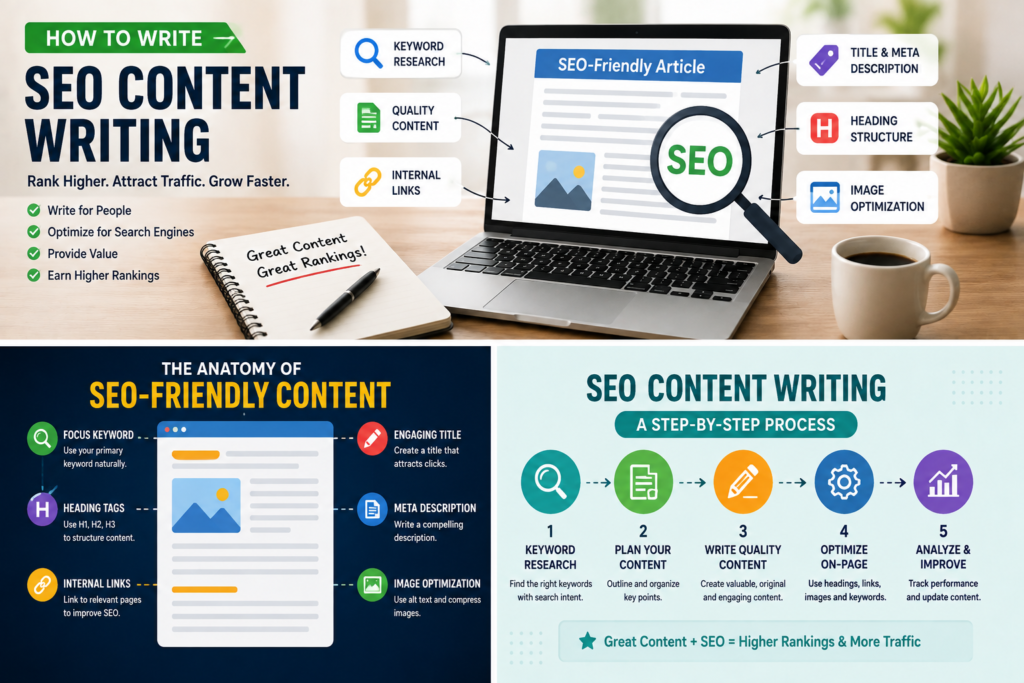
A strong structure improves readability and enhances SEO performance. Search engines use headings to identify topic relationships and determine content relevance.
Optimizing H1, H2, H3, and H4 Tags
Your heading structure should follow a logical hierarchy:
- H1: Main topic
- H2: Major sections
- H3: Subtopics
- H4: Supporting details
Proper heading usage helps both humans and machines understand your content. Modern SEO guidelines emphasize clear semantic organization because AI systems frequently extract information directly from structured content.
Writing Engaging Introductions
The introduction determines whether visitors stay or leave. You have only a few seconds to capture attention.
A strong introduction should:
- Identify the problem
- Promise value
- Preview the solution
For example, imagine trying to rank your content but receiving no traffic despite hours of effort. Frustrating, right? That’s exactly why SEO-friendly content matters. An engaging introduction creates an emotional connection while signaling relevance to both readers and search engines.
Keep introductions concise but compelling. Avoid unnecessary fluff and get to the point quickly. Search engines increasingly favor content that delivers immediate value rather than lengthy, vague openings.
Creating High-Quality Content
Quality remains Google’s most important ranking factor. You can optimize every technical detail perfectly, but poor content rarely succeeds long-term.
High-quality content answers questions thoroughly, provides original insights, and demonstrates expertise. Think of it as becoming the most helpful person in the room.
Focus on User Experience
User experience influences SEO more than many people realize.
Consider:
- Readability
- Mobile responsiveness
- Visual elements
- Content organization
- Page speed
Readers should easily navigate your content without feeling overwhelmed.
Demonstrate Expertise
Google’s emphasis on Experience, Expertise, Authoritativeness, and Trustworthiness (E-E-A-T) means expertise matters more than ever.
Ways to demonstrate expertise include:
- Sharing personal experiences
- Including case studies
- Citing credible sources
- Using industry statistics
- Providing actionable advice
Studies and industry observations suggest content supported by expert insights, current statistics, and credible references performs better across traditional search and AI-powered search environments.
On-Page SEO Best Practices
On-page SEO ensures your content communicates effectively with search engines.
Optimizing Title Tags
Title tags remain one of the strongest ranking signals.
Best practices:
- Include primary keyword
- Stay under 60 characters
- Create curiosity
- Emphasize benefits
Example:
How to Write SEO-Friendly Content: 15 Proven Strategies
Writing Meta Descriptions
Meta descriptions influence click-through rates.
Example:
“Learn how to write SEO-friendly content that ranks higher, attracts organic traffic, and converts readers into customers.”
Aim for 150–160 characters.
Internal Linking Strategy
Internal links connect related content throughout your website.
Benefits include:
- Improved crawlability
- Better user navigation
- Increased page authority distribution
- Longer session duration
Link naturally to relevant pages that provide additional value.
Image Optimization
Images improve engagement but require optimization.
Key practices:
- Use descriptive filenames
- Add alt text
- Compress images
- Choose relevant visuals
Optimized images contribute to accessibility and search visibility while improving overall user experience.
SEO Content for AI Search and GEO
Search behavior is evolving rapidly. AI-powered search platforms such as ChatGPT, Gemini, Perplexity, and Google’s AI Overviews increasingly influence how people discover information.
This shift has created a growing focus on Generative Engine Optimization (GEO).
Content optimized for AI search should:
- Answer questions directly
- Use clear headings
- Include factual information
- Demonstrate authority
- Provide structured content
Recent research highlights the importance of machine-readable content, semantic relationships, and clear information architecture for AI-driven search visibility.
Writing for Featured Snippets
Featured snippets often appear above traditional search results.
To improve snippet opportunities:
- Answer questions directly.
- Use concise definitions.
- Create numbered steps.
- Organize content clearly.
- Include FAQ sections.
Example:
What is SEO-friendly content?
SEO-friendly content is content optimized to rank in search engines while providing value and relevance to readers.
Simple, direct answers are easier for search engines and AI systems to extract and display.
Common SEO Content Mistakes
Even experienced writers make SEO mistakes that hurt rankings.
Common issues include:
| Mistake | Consequence |
|---|---|
| Keyword Stuffing | Lower rankings |
| Ignoring Search Intent | High bounce rates |
| Thin Content | Poor engagement |
| Weak Headings | Reduced clarity |
| Missing Internal Links | Lost authority |
| Duplicate Content | Indexing issues |
Another growing mistake is focusing solely on keywords while ignoring semantic relevance. Search engines now evaluate topic coverage rather than simple keyword frequency. Writers who obsess over exact-match keywords often miss the broader context users expect.
Measuring Content Performance
Creating SEO-friendly content is only half the job. The other half involves measuring results.
Track key metrics including:
- Organic traffic
- Keyword rankings
- Click-through rates
- Bounce rates
- Conversions
- Average session duration
Popular tools include:
- Google Analytics
- Google Search Console
- Ahrefs
- SEMrush
Performance data helps identify strengths and weaknesses. Successful SEO is an ongoing process of testing, analyzing, and improving.
Review content regularly and update outdated information. Fresh, relevant content often performs better than static pages left untouched for years. Many high-ranking websites continuously refresh statistics, examples, and recommendations to maintain search visibility.
Conclusion
Writing SEO-friendly content is no longer about squeezing keywords into every paragraph. Success comes from understanding search intent, creating exceptional content, structuring information logically, and optimizing for both traditional search engines and AI-powered discovery platforms. The most effective content combines relevance, expertise, readability, and technical optimization into a seamless experience for readers.
As search technology evolves, the fundamentals remain surprisingly consistent: answer questions clearly, provide genuine value, and make your content easy to understand. Whether someone finds your article through Google, ChatGPT, Gemini, or another AI-powered platform, useful content continues to win. Focus on helping your audience first, and search visibility will often follow naturally.
FAQs
1. What is SEO-friendly content?
SEO-friendly content is content optimized for search engines while providing valuable information that satisfies user intent and improves user experience.
2. How many keywords should I use in an article?
There is no fixed number. Use your primary keyword naturally and include related terms where relevant without keyword stuffing.
3. Is long-form content better for SEO?
Long-form content often performs well because it covers topics comprehensively, but quality and relevance matter more than word count alone.
4. How important are headings for SEO?
Headings help search engines understand content structure and improve readability, making them highly important for SEO.
5. Can AI-generated content rank on Google?
AI-generated content can rank if it provides accurate, helpful, original, and high-quality information that satisfies user intent and meets quality guidelines.
Advanced SEO Content Writing Strategies for Higher Rankings
Creating SEO-friendly content is not just about writing articles and adding keywords. The most successful websites follow advanced strategies that help them stand out in competitive search results. Search engines have become smarter, and they now analyze user behavior, content quality, topical authority, and engagement metrics before deciding where a page should rank. If you want your content to perform well in 2026 and beyond, you need to think beyond basic optimization.
One effective strategy is creating topic clusters. Instead of publishing random articles, focus on building a group of interconnected content pieces around a central topic. For example, if your main topic is “SEO,” you can create supporting articles about keyword research, link building, technical SEO, on-page SEO, and content marketing. These articles should link to one another naturally. This structure helps search engines understand that your website has deep expertise in a subject area, increasing your chances of ranking for multiple related keywords.
Another important factor is content freshness. Search engines prefer content that remains accurate and relevant. Updating existing articles with new statistics, examples, screenshots, and industry trends can significantly improve rankings. Rather than publishing hundreds of new articles, many successful websites gain traffic by improving content they already have. Think of your content like a garden; it needs regular maintenance to continue growing and producing results.
Building Topical Authority
Topical authority refers to how much trust search engines place in your website for a specific subject. When a website consistently publishes valuable content about one niche, it becomes more authoritative in the eyes of search engines.
For example, a website dedicated to digital marketing has a better chance of ranking for SEO-related terms than a general website that occasionally publishes marketing content. Search engines recognize patterns in content creation and reward websites that demonstrate consistent expertise.
To build topical authority:
- Cover all aspects of your niche.
- Create detailed pillar pages.
- Publish supporting content regularly.
- Link related articles together.
- Update outdated content frequently.
The stronger your topical authority becomes, the easier it is to rank for competitive keywords because search engines begin viewing your website as a trusted source of information.
The Role of User Experience in SEO
User experience (UX) and SEO are now deeply connected. Search engines want users to have positive experiences when they visit websites. If visitors quickly leave your page because it is slow, confusing, or difficult to read, your rankings may suffer over time.
A good user experience begins with readability. Large blocks of text can overwhelm readers, especially on mobile devices. Breaking content into shorter paragraphs, using descriptive headings, and incorporating visuals can make information easier to consume. Imagine walking into a library where every book is thrown into a single pile. Finding information would be nearly impossible. Proper formatting creates organization and clarity.
Page speed is another critical factor. Studies consistently show that users expect websites to load within a few seconds. Slow-loading pages increase bounce rates and reduce engagement. Compressing images, minimizing unnecessary scripts, and using reliable hosting services can improve performance.
Mobile optimization is equally important because a majority of searches now occur on smartphones. Your content should look and function perfectly across all devices. Responsive design, readable fonts, and fast loading times help create a seamless experience for users regardless of screen size.
Improving Engagement Metrics
Engagement metrics provide valuable signals about content quality. While search engines do not publicly confirm every ranking factor, user engagement often correlates strongly with better rankings.
Important engagement metrics include:
| Metric | Why It Matters |
|---|---|
| Time on Page | Indicates reader interest |
| Bounce Rate | Measures immediate exits |
| Pages per Session | Shows deeper engagement |
| Click-Through Rate | Reflects title effectiveness |
| Return Visitors | Demonstrates content value |
Improving these metrics requires focusing on user needs rather than simply targeting keywords. Engaging content encourages readers to stay longer, explore additional pages, and return in the future.
Writing Content That Converts Visitors
Ranking on Google is valuable, but traffic alone does not guarantee success. The ultimate goal is often generating leads, sales, subscribers, or other meaningful actions. This is where conversion-focused content becomes essential.
Conversion-focused content addresses reader concerns, builds trust, and guides users toward a desired action. It starts by understanding your audience’s pain points. What challenges are they facing? What solutions are they seeking? When your content speaks directly to these needs, readers are more likely to engage with your brand.
Storytelling can be particularly effective. Instead of simply presenting facts, use examples and real-world scenarios to illustrate your points. Stories create emotional connections and make information more memorable. Readers often remember experiences and examples long after they forget statistics.
Calls-to-action (CTAs) also play a significant role. Every article should guide readers toward a logical next step, whether that’s downloading a guide, subscribing to a newsletter, requesting a consultation, or reading another article. Effective CTAs feel natural and helpful rather than pushy or sales-oriented.
Future Trends in SEO Content Writing
The future of SEO content writing is being shaped by artificial intelligence, voice search, and evolving user expectations. Content creators who adapt early will have a significant advantage over competitors who rely solely on outdated strategies.
Voice search continues to grow as more users interact with digital assistants. Voice searches tend to be longer and more conversational than traditional text searches. Instead of typing “best SEO tips,” users might ask, “What are the best SEO tips for a small business website?” Content optimized for natural language queries can capture this growing audience.
AI-powered search experiences are also changing how content is discovered. Search engines increasingly generate summaries, answer boxes, and AI-driven responses directly within search results. To remain visible, content must provide clear, authoritative, and structured information that AI systems can easily understand and reference.
Personalization is another emerging trend. Search engines are becoming better at delivering results tailored to individual users. This means content creators should focus on understanding audience segments and creating highly relevant experiences rather than targeting broad audiences with generic content.
The future belongs to content that combines human expertise, authentic experiences, and strategic optimization. While technology continues to evolve, the core principle remains the same: create content that genuinely helps people solve problems and achieve their goals. When you consistently provide value, search engines, AI systems, and readers are all more likely to reward your efforts.