
Email Marketing Strategies to Increase Customers services
Email marketing is one of the most effective digital marketing strategies for building relationships with customers, increasing brand awareness, and encouraging repeat purchases. Unlike many other marketing channels, email allows businesses to communicate directly with people who have already shown interest in their products, services, or content.
However, simply sending emails is not enough. Businesses need to create valuable, relevant, and personalized messages that encourage subscribers to open, read, and interact with them. Effective email marketing strategies can improve customer engagement, strengthen customer relationships, and ultimately support business growth.
This guide explores practical email marketing strategies to increase customer engagement, including personalization, segmentation, compelling content, automation, interactive emails, optimization, and performance measurement.
What Is Email Marketing?
Email marketing is a digital marketing method that involves sending promotional, informational, or relationship-building messages to a group of subscribers through email.
Businesses use email marketing for several purposes, including:
- Promoting products and services
- Sharing company news
- Sending newsletters
- Offering discounts and promotions
- Welcoming new subscribers
- Educating customers
- Recovering abandoned carts
- Collecting customer feedback
- Building long-term relationships
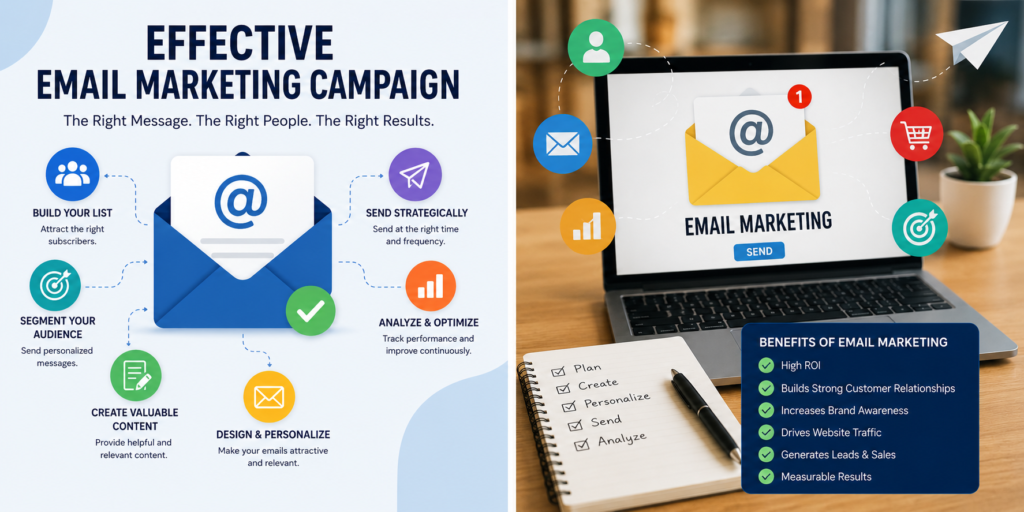
A successful email marketing campaign focuses on delivering the right message to the right person at the right time.
Why Customer Engagement Matters in Email Marketing
Customer engagement refers to the level of interaction and interest customers have with a brand. In email marketing, engagement can include opening emails, clicking links, responding to messages, downloading resources, making purchases, or sharing content.
High engagement indicates that subscribers find your emails useful and relevant.
Benefits of Higher Customer Engagement
Strong customer engagement can provide several benefits:
- Improved customer relationships
Regular and valuable communication helps businesses develop stronger relationships with their audience. - Higher conversions
Engaged subscribers are more likely to click on offers and purchase products or services. - Better customer retention
Customers who receive useful communication are more likely to remain connected with a brand. - Increased brand awareness
Consistent emails help customers remember your business. - Better marketing performance
Engaged audiences can generate stronger results from email campaigns.
Email Marketing Strategies to Increase Customer Engagement
1. Build a High-Quality Email List
The foundation of successful email marketing is a high-quality email list. Businesses should focus on attracting people who genuinely want to receive their communications rather than collecting random email addresses.
Avoid purchasing email lists because these contacts may not be interested in your business and can negatively affect campaign performance.
Use Website Sign-Up Forms
Place email subscription forms in useful locations on your website, such as:
- Homepage
- Blog pages
- Landing pages
- Checkout pages
- Contact pages
- Resource pages
Explain what subscribers will receive after signing up.
For example, you could offer:
- Weekly marketing tips
- Exclusive discounts
- Free guides
- Industry updates
- Educational content
Use Lead Magnets
A lead magnet is something valuable offered in exchange for a visitor’s email address.
Examples include:
- E-books
- Checklists
- Templates
- Free courses
- Reports
- Guides
- Webinars
The more relevant the lead magnet is to your audience, the more likely people are to subscribe.
2. Segment Your Email Audiencehttps://www.linkedin.com/in/saniya-amreen-67008737a
Email segmentation is one of the most effective ways to improve customer engagement.
Instead of sending the same email to everyone, divide your subscribers into smaller groups based on their interests, behavior, demographics, or purchasing history.
Common Segmentation Methods
You can segment subscribers based on:
- Age group
- Location
- Gender where appropriate
- Interests
- Previous purchases
- Website activity
- Email engagement
- Customer status
- Purchase frequency
- Signup source
For example, an online clothing store could create separate segments for customers interested in men’s clothing, women’s clothing, shoes, and accessories.
Why Segmentation Works
Segmentation allows businesses to create more relevant messages.
A customer who regularly purchases running shoes may be more interested in information about running products than an email about formal shoes.
Relevant content can encourage more opens, clicks, and conversions.
3. Personalize Your Emails
Personalization goes beyond simply adding a subscriber’s name to an email.
Modern email marketing can use customer information and behavior to provide more relevant content.
Use Personalized Recommendations
Businesses can recommend products based on:
- Previous purchases
- Browsing behavior
- Wishlist activity
- Product interests
- Previous email interactions
For example:
“Based on your recent purchase, you may also like these products.”
This type of communication can make customers feel that the email was created specifically for them.
Personalize Subject Lines
Personalized subject lines can make an email feel more relevant.
Instead of a generic subject line such as:
“Our New Products Are Here”
a business could create something more specific to the subscriber’s interests.
The goal is to make the subject line useful and relevant without appearing overly intrusive.
4. Create Compelling Subject Lines
The subject line is one of the first things subscribers see. A strong subject line can encourage people to open an email, while a weak one may be ignored.
Characteristics of Effective Subject Lines
A good subject line should be:
- Clear
- Concise
- Relevant
- Interesting
- Honest
- Appropriate for the audience
Examples include:
- “5 SEO Tips You Can Use Today”
- “Your Exclusive Weekend Offer”
- “New Digital Marketing Guide Inside”
- “Don’t Miss Our Latest Updates”
Avoid misleading subject lines because they can damage trust.
Create Curiosity
Curiosity can encourage subscribers to open emails, but it should be used carefully.
For example:
“Are You Making These Common SEO Mistakes?”
This creates curiosity while clearly communicating the topic.
5. Provide Valuable Email Content
Customers do not want to receive promotional messages all the time. If every email asks subscribers to buy something, they may lose interest or unsubscribe.
A successful email marketing strategy balances promotional content with useful information.
Types of Valuable Content
You can share:
- Educational articles
- How-to guides
- Industry tips
- Case studies
- Customer stories
- Product tutorials
- Company updates
- Helpful resources
- Special offers
The content should solve problems or provide value to your audience.
Follow the 80/20 Principle
A useful approach is to provide mostly valuable or educational content while using a smaller portion of your communication for direct promotion.
The exact balance depends on the business and audience, but the principle is simple: give value before asking for a sale.
6. Use Email Automation
Email automation allows businesses to send relevant messages automatically based on specific triggers or customer actions.
Automation saves time while creating timely communication.https://amreensaniya.shop/index.php/2026/08/08/email-marketing-strategies-to-increase-customer-engagement/
Welcome Emails
A welcome email is sent when someone joins your email list.
A welcome series can:
- Thank the subscriber
- Introduce the business
- Explain what they can expect
- Provide useful content
- Introduce important products or services
A strong welcome experience can establish a positive relationship from the beginning.
Abandoned Cart Emails
E-commerce businesses can send reminders when customers add products to their shopping carts but do not complete their purchases.
An abandoned cart sequence might include:
- A reminder
- Product benefits
- Customer reviews
- A final reminder
The messaging should remain helpful rather than aggressive.
Re-Engagement Emails
Some subscribers become inactive over time.
A re-engagement campaign can remind inactive subscribers about your brand.
For example:
“We Miss You — Here’s What’s New”
You can provide useful content, ask about their preferences, or give them an opportunity to update their email preferences.
7. Use a Strong Call-to-Action
Every marketing email should have a clear purpose.
The call-to-action, or CTA, tells the subscriber what to do next.
Examples include:
- Shop Now
- Learn More
- Download the Guide
- Read the Article
- Book a Consultation
- Register Now
- Get Started
Keep CTAs Clear
Avoid giving subscribers too many competing actions.
If the main goal of an email is to encourage people to download an e-book, the primary CTA should focus on downloading the e-book.
A clear CTA makes it easier for customers to take action.
8. Make Emails Mobile-Friendly
Many people read emails using smartphones and tablets. Therefore, mobile optimization is essential.
A poorly designed email may be difficult to read on a small screen.
Mobile Email Best Practices
Use:
- Responsive email designs
- Readable fonts
- Short paragraphs
- Clear buttons
- Proper spacing
- Optimized images
- Simple layouts
Test emails on different screen sizes before sending them.
A mobile-friendly design creates a better user experience and can encourage more engagement.
9. Use Visual Content Carefully
Images, graphics, icons, and other visual elements can make email content more attractive.
However, visual content should support the message rather than distract from it.
Use Relevant Images
For an online clothing business, high-quality product images can help customers understand products quickly.
For an educational company, infographics and diagrams may communicate information more effectively.
Optimize Images
Large image files can slow loading times. Compress images while maintaining reasonable quality.
Also use descriptive alternative text when appropriate so that important information is still understandable when images do not load.
10. Add Interactive Elements
Interactive email elements can encourage subscribers to actively participate instead of simply reading.
Depending on the email platform and email client, businesses can use:
- Surveys
- Polls
- Quizzes
- Ratings
- Interactive buttons
- Product selections
- Feedback forms
Use Polls and Surveys
For example, a digital marketing company could ask:
“Which topic do you want us to cover next?”
Options could include:
- SEO
- Social media marketing
- Email marketing
- Content marketing
This creates interaction while also providing valuable information about customer interests.
11. Send Emails at the Right Time
Timing can influence email engagement.
If an email arrives when subscribers are busy or unlikely to check their inbox, it may receive less attention.
Businesses should analyze their own audience data to identify effective sending times.
Test Different Sending Times
You can experiment with:
- Morning
- Afternoon
- Evening
- Weekdays
- Weekends
There is no single perfect time for every business. The best timing depends on your audience, industry, location, and customer behavior.
12. Maintain a Consistent Email Schedule
Consistency helps customers know when to expect communication from your brand.
For example, a company could send:
- Weekly newsletters
- Monthly updates
- Product announcements
- Seasonal campaigns
However, avoid sending too many emails.
Avoid Email Fatigue
Email fatigue occurs when subscribers receive too many messages and become less interested.
Monitor engagement metrics and adjust your frequency when necessary.
Quality is generally more important than quantity.
13. Use A/B Testing
A/B testing allows marketers to compare two versions of an email element to determine which performs better.
You can test:
- Subject lines
- CTA wording
- Email designs
- Images
- Offers
- Headlines
- Sending times
Example of A/B Testing
Version A:
“Get 20% Off Today”
Version B:
“Your Exclusive 20% Discount Is Waiting”
Send each version to a portion of your audience and compare performance.
The results can help you understand what your subscribers respond to.
14. Encourage Customer Feedback
Customer feedback can strengthen relationships and provide valuable business insights.
Ask subscribers what they think about:
- Products
- Services
- Website experience
- Email content
- Customer support
- New ideas
Create Simple Feedback Requests
Keep feedback forms short and easy to complete.
You could ask:
“How was your experience with us?”
Then provide a simple rating system or short response field.
Customers are more likely to respond when the process is quick and convenient.
15. Create Exclusive Offers for Subscribers
Exclusive content and offers can make subscribers feel valued.
Businesses can provide:
- Subscriber-only discounts
- Early product access
- Special bundles
- Free resources
- Event invitations
- Limited-time promotions
Build a Sense of Exclusivity
For example:
“Early Access: New Collection Available to Subscribers First.”
This can encourage subscribers to remain connected with the brand.
16. Use Storytelling in Emails
Storytelling can make email content more memorable and emotionally engaging.
Instead of simply listing product features, explain how a product or service helped solve a customer’s problem.
Share Customer Stories
A customer story could describe:
- The customer’s challenge
- The solution they discovered
- Their experience
- The result
Authentic stories can make marketing messages more relatable.
17. Create Educational Email Series
An email series can teach subscribers something valuable over several messages.
For example, a digital marketing company could create a five-day series:
Day 1: SEO Basics
Introduce the fundamentals of search engine optimization.
Day 2: Keyword Research
Explain how businesses can identify relevant search terms.
Day 3: On-Page SEO
Discuss titles, headings, content, and internal links.
Day 4: Off-Page SEO
Explain backlinks and online authority.
Day 5: SEO Checklist
Provide a practical checklist subscribers can use.
Educational sequences can keep subscribers engaged while positioning the business as a useful source of information.
Measuring Email Marketing Engagement
Creating campaigns is only the beginning. Marketers need to measure performance to understand what works.
Important Email Marketing Metrics
Open Rate
Open rate indicates the percentage of delivered emails that were opened, though modern email privacy features can make this metric less precise than it once was.
Click-Through Rate
Click-through rate measures how many recipients clicked links within an email.
It can help determine whether your content and CTAs encourage action.
Conversion Rate
Conversion rate measures the percentage of recipients who complete a desired action, such as purchasing a product or submitting a form.
Unsubscribe Rate
This shows how many subscribers leave your email list.
A sudden increase may indicate problems with content relevance, frequency, or targeting.
Bounce Rate
Bounce rate measures emails that could not be successfully delivered.
Keeping your email list clean can help maintain good deliverability.
Common Email Marketing Mistakes to Avoid
Sending Too Many Emails
Sending emails too frequently can annoy subscribers and increase unsubscribes.
Using Misleading Subject Lines
Clickbait may increase opens temporarily but can damage trust.
Ignoring Mobile Users
Emails that are difficult to read on smartphones can reduce engagement.
Making Every Email Promotional
Customers need valuable content, not constant sales messages.
Not Segmenting Your Audience
Sending identical content to every subscriber can make communication less relevant.
Ignoring Analytics
Without measuring performance, marketers may continue using strategies that are not effective.
Best Practices for Successful Email Marketing
To improve customer engagement, businesses should follow these best practices:
- Build permission-based email lists.
- Segment subscribers based on relevant information.
- Personalize content when appropriate.
- Write clear and engaging subject lines.
- Provide useful information.
- Use strong calls-to-action.
- Optimize emails for mobile devices.
- Use automation for timely communication.
- Test different email elements.
- Monitor campaign performance.
- Keep subscriber preferences in mind.
- Maintain a consistent sending schedule.
- Respect privacy and email marketing regulations.
Conclusion
Email marketing remains an important digital marketing strategy for businesses that want to build meaningful relationships with customers. However, successful email marketing is not simply about sending more emails. It is about delivering relevant content, understanding customer needs, and creating valuable experiences.
Strategies such as audience segmentation, personalization, automation, valuable content, strong CTAs, mobile optimization, storytelling, interactive elements, A/B testing, and performance tracking can significantly improve customer engagement.
Businesses should continuously analyze their results and learn from customer behavior. Instead of using the same approach for every subscriber, marketers should create targeted campaigns that provide genuine value.
When email marketing is used strategically, it can help businesses attract attention, build trust, increase customer loyalty, encourage repeat purchases, and support long-term growth. The most effective email marketing strategy is one that puts the customer first and focuses on delivering the right message at the right time.